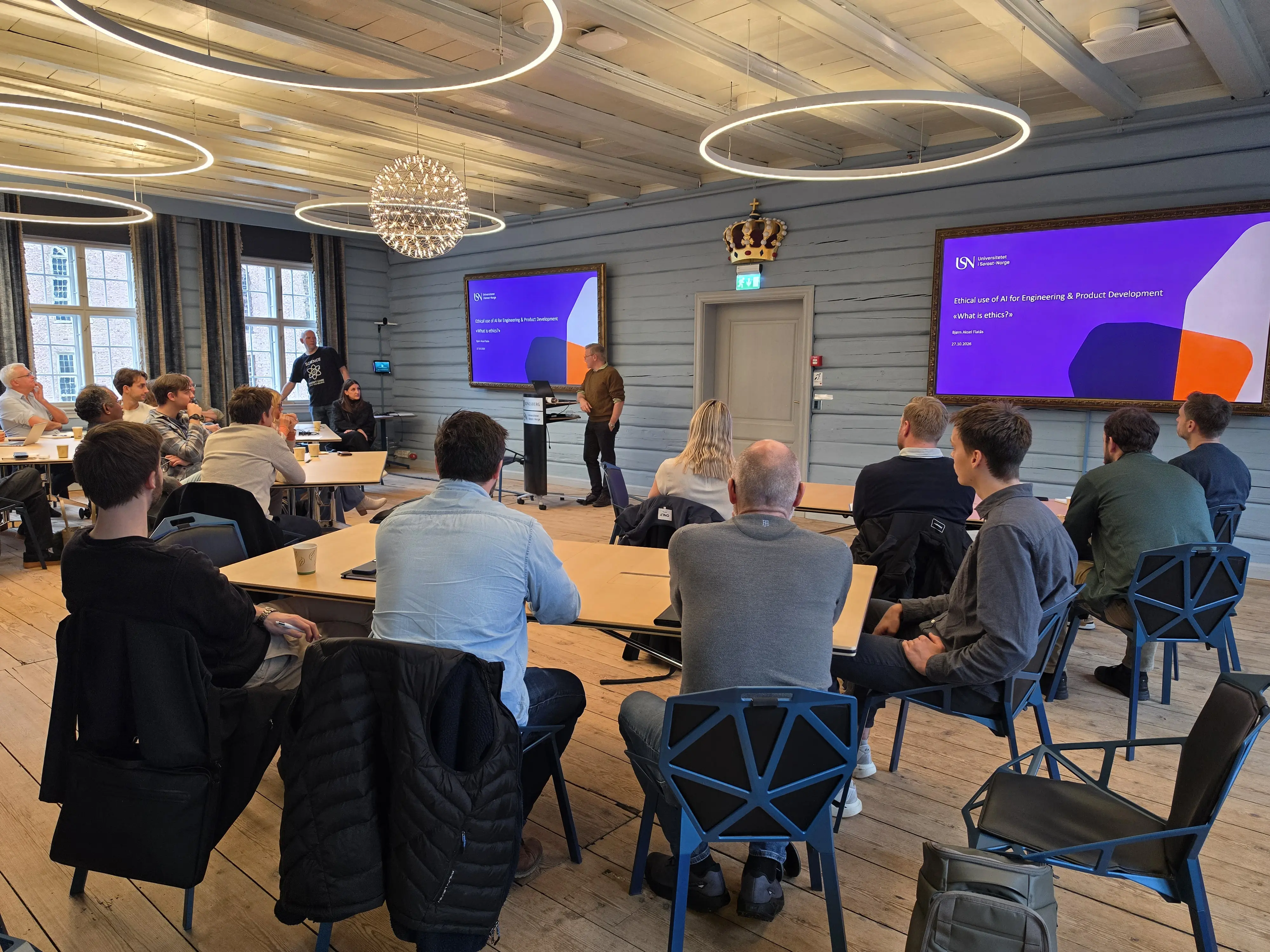
On 27 October, at Bergseminaret, we had the pleasure of hosting the seminar Ethical Use of AI for Engineering & Product Development together with the Industrial Research School in Complex Systems INRESCOS, bringing together industry partners, researchers, and PhD candidates to explore one of the most pressing challenges in technology development today: how to use AI responsibly.
How do we use AI responsibly in engineering and product development? Who benefits when AI makes delivery faster: the customer, the supplier, or both? Do rules and regulations describe where information may go, or only which tools are allowed? How do we choose the right model, and how much can we trust its output?
These were some of the questions explored throughout the seminar.
The seminar combined philosophical perspectives with practical industry experience through ethical dilemmas, real-world cases, group discussions, and reflection. Participants were challenged to think beyond the technology itself and consider the broader implications of AI in engineering and product development.
Discussions were anchored in three industry cases addressing the use of AI in product development, AI-assisted engineering, and software development. The cases examined the relationship between AI tools and human judgement, the choices involved in adopting AI responsibly, and the challenges that arise when technological development moves faster than regulation.
Exploring the Ethical Dimensions of AI
The seminar addressed both practical and philosophical perspectives on AI, including:
- What is ethical theory, and what purpose does it serve?
- What do we mean when we describe something as ethical or unethical?
- How does ethical reflection differ from ethical evaluation?
- How should we weigh different factors when selecting an AI model?
- How do we assess the quality and reliability of AI-generated output?
- Will access to a model remain available in the future, and what are the implications if it does not?
Participants explored what trustworthy AI means in practice, the choices and compromises involved in using AI, and why it is important to make decisions that can be clearly explained to customers and managers.
Learning from Industry and Academia
Thanks to Bjørn Aksel Flatås (USN), Olaf H. Graven (USN), Per Kevin Braathen (Knightec Group), and Olaf Talmo and Sebastian Østby from KONGSBERG's AI team for sharing their expertise, experiences, and perspectives. Their contributions, practical examples, and engaging discussions made this seminar both highly valuable and inspiring.
As AI becomes an increasingly important part of engineering and product development, ethical reflection is not just a theoretical exercise, but an essential prerequisite for making responsible and sustainable decisions in practice.
The seminar demonstrated that while technologies may change rapidly, the need to critically examine their impact, limitations, and consequences remains as important as ever.
We are grateful to everyone who contributed to the discussions and helped make the seminar a success.